Fieldbook
A private, local-first task tracker for tasks, subtasks, priorities, due dates, focus work, time tracking, and backup/restore.
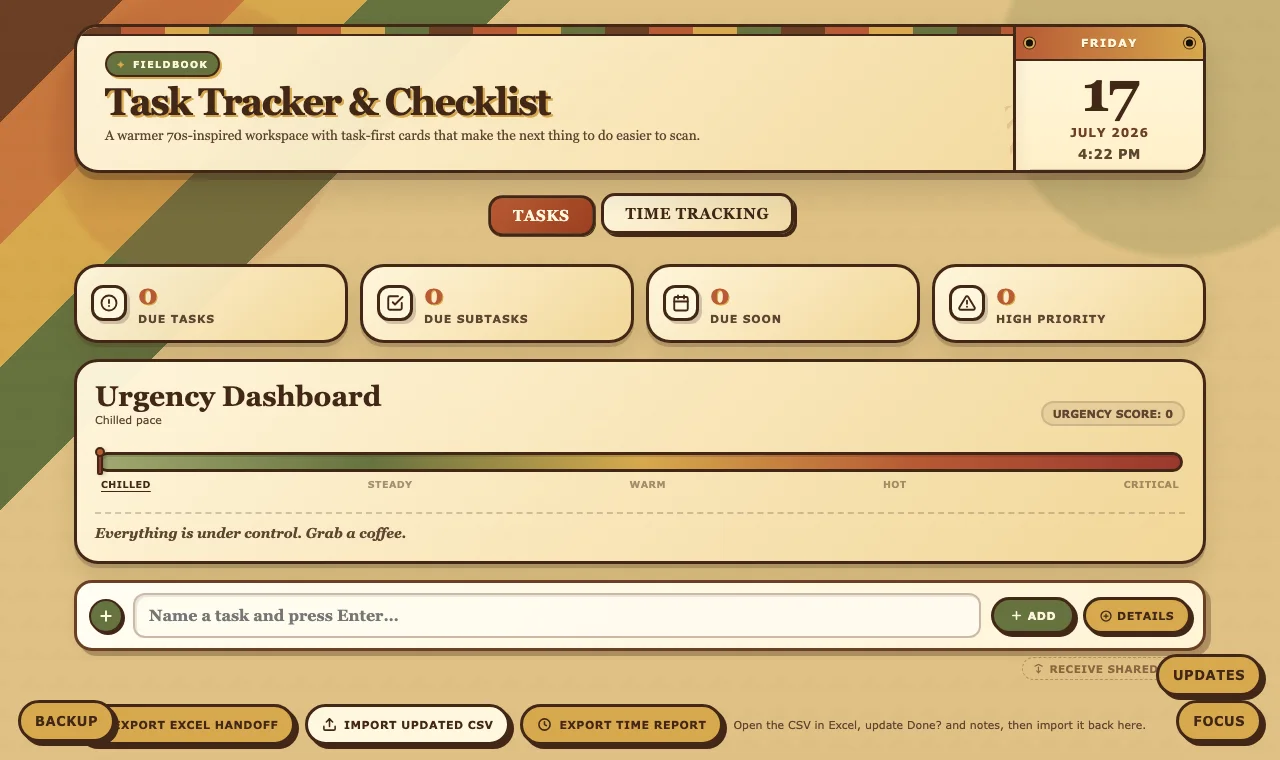
Better than another spreadsheet.
I wanted a focused alternative to spreadsheet-shaped task tracking — something private, self-contained, and pleasant to use every day.
One rule shaped the whole thing: it had to stay local, like a spreadsheet. No servers, no accounts, no sign-up. Your data lives in your browser, and a one-click backup file is the entire sync story.
A complete product, not a snippet.
Fieldbook is a working local-first task tracker with tasks and subtasks, priorities, due dates, a focus mode, time tracking, and backup/restore.
The application ships as one self-contained HTML file. No framework, account, or backend is required.
Architect first, then direct.
I started by specifying the design system — tokens, the press metaphor, the motion language — then directed the coding agent to build each component against that spec, reviewing and correcting every pass.
The hard calls were mine: the button-press shadow math (the face translates while the shadow shrinks so its outer edge stays planted), a two-layer reduced-motion strategy, and the discipline of keeping it all in one file.
“The engineering work starts with clear constraints, then continues through review, testing, correction, and release.”
14 colors, 2 shadows, 19 motions.
One :root defines the whole language: an earthy palette, a hard-offset shadow scale, a serif/sans split, and a CSS-variable button-press system — plus 19 keyframe micro-interactions, all gated behind a reduced-motion strategy.
A complete, polished product — design system and all — delivered as one local-first application.
That's the whole pitch in one project.